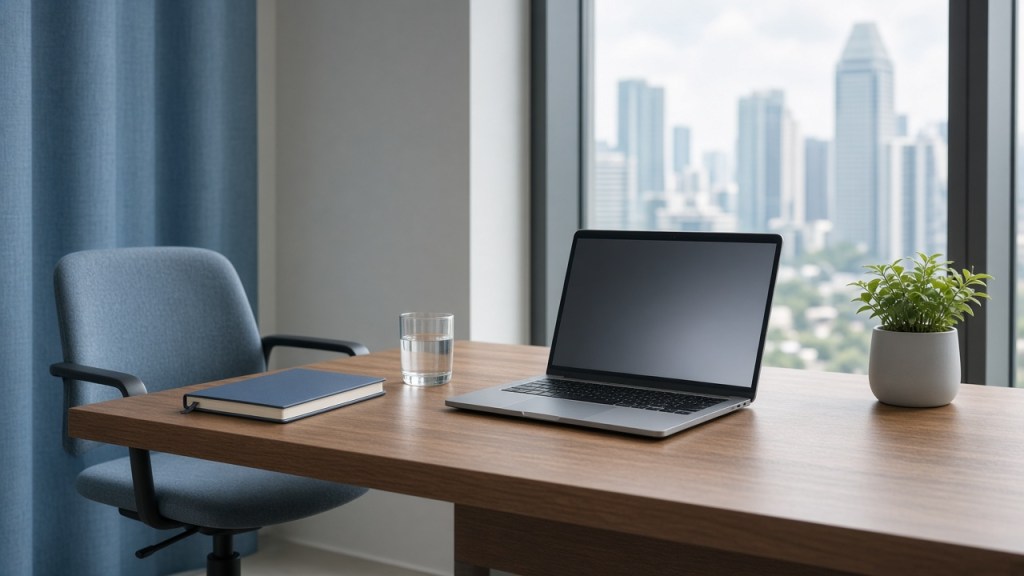
A complete guide for desk-bound professionals in Singapore who split the week between the office and home — and for anyone else whose workday is a long sit. After reading, you should be able to set up the chair you have, build movement into the day, and decide whether a comfort piece would help.
In this guide
- What a hybrid desk day actually looks like
- Set up the chair you have
- Screen, keyboard and the air-conditioning
- Build movement into the day
- The commute and the end of the day
- If you only change one thing
- FAQ
- Sources
A hybrid week in Singapore is rarely one perfect desk, used the same way every day. Tuesday might be a standard office chair in a cold meeting room. Thursday might be a dining chair in an HDB living room, with the laundry rack just out of a video-call frame. In between there is often an MRT ride, a laptop bag, and a lunch that is either a short walk to a hawker centre or another meal at the same seat.
Singapore is, by some industry measures, a distinctly hybrid market. The 2026 Asia Pacific Workplace Insights report by Colliers, cited by The Straits Times in November 2025, found that 87 per cent of organisations here allowed employees to split time between home and the office. That split is now familiar. What is less often discussed is how differently the two chairs feel, and how easy it is for a home day to become eight hours in one seat.
The aim of this guide is not to sell you a new office. It is to make the long desk day you already have a little more comfortable: the chair, the screen, the rhythm of getting up, and, if you want them, a few optional tools for support and warmth. This is general information, not medical advice.
What a hybrid desk day actually looks like
In the office, you may not be allowed to swap the chair. You may move from your desk to a glass meeting room and back again, each seat a little different. At home, the “desk” may be a dining table, a hall desk or a corner of the living room. The work is the same. The furniture is not.
That variety can be useful, if you use it. A day with meetings is a day with natural reasons to stand and walk. A day at home can quietly become eight hours in one chair, because the pantry trip and the walk to the next room have disappeared.
Flexible work is now more common than it was before the pandemic. Around seven in 10 firms in Singapore offered flexible work arrangements in 2024, according to the Ministry of Manpower, as reported by CNA. Since late 2024, employers have been required to properly consider formal requests under tripartite guidelines. The practical question for a hybrid worker is more ordinary: how to sit more comfortably in both rooms, without assuming that one setup will do for both.
Set up the chair you have
Wherever you are, start with the chair, then bring the desk to you. Sit all the way back so your hips meet the backrest. Rest your feet flat on the floor, or on a footrest if the chair is too high. Let your shoulders drop. If you work in a chair you cannot adjust, these habits still matter.
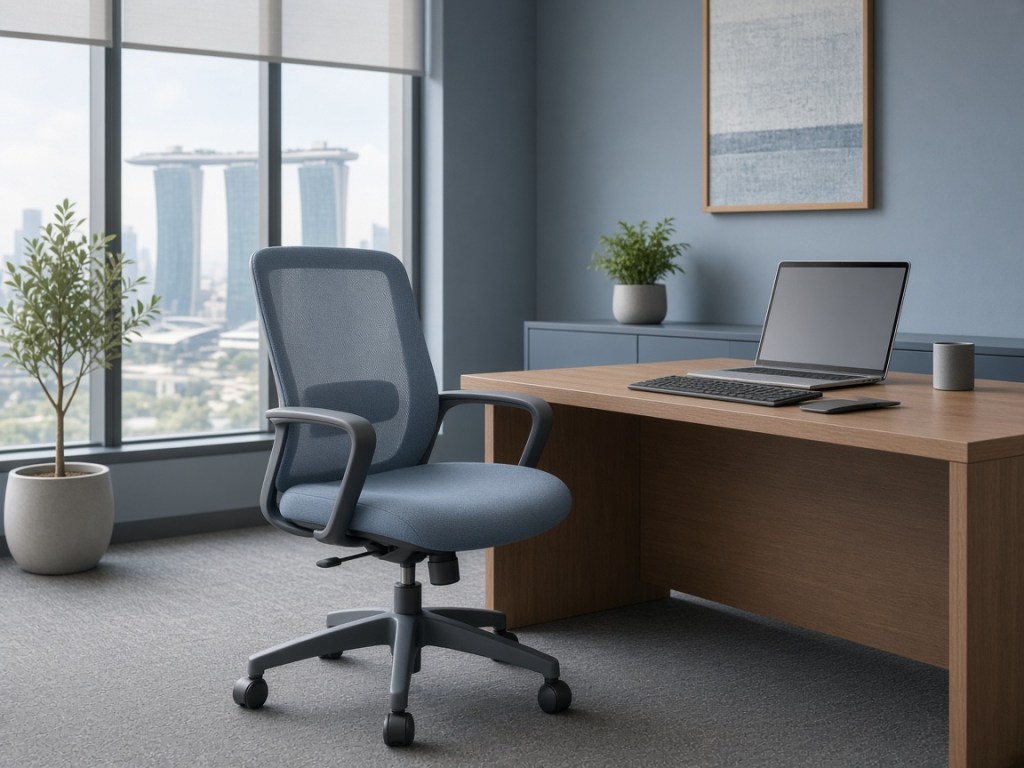
Mayo Clinic suggests sitting with as much lower-back support as you can, keeping knees and hips at a comfortable level, and changing position at least every half hour. In an office chair with a lumbar support, try it at a height that actually meets your back. In a dining chair, a rolled towel or a small lumbar cushion can fill a visible gap.
If you work from a dining chair on home days, the seat itself may be the harder part. Our companion guide, How to Make a Hard Dining Chair Work as a Desk Chair, walks through that setup in more detail. The short version is the same: sit back, support your feet, raise the screen, and take breaks.
HealthHub’s sitting guidance is worth keeping in mind in both rooms: it is a myth that a perfectly straight, unchanging posture is the goal. A sit you can leave is more useful than a pose you try to hold until six o’clock.
Screen, keyboard and the air-conditioning
HealthHub recommends sitting at a comfortable distance from the screen, with the top of the display at or slightly below eye level, and paying attention to lighting and air-conditioning. Those points travel well between the office and home.
- If you use a laptop, raise the screen and use a separate keyboard and mouse when you can, especially at home.
- Keep the keyboard close, so your elbows stay near your sides and your wrists stay reasonably straight.
- Avoid squinting at a dim screen in a bright window, or at a bright screen in a dark room. Shift the desk, the blinds or the lamp rather than your neck.
In a cold office, shoulders often creep towards the ears without you noticing. A light layer, a pause to drop the shoulders, and a brief stand between meetings usually help more than hunching through the afternoon. At home, the opposite problem can appear: a warm flat, a low sofa nearby, and the temptation to finish “just one more email” in a shape the dining chair was never meant to hold.
Build movement into the day
This is the centre of a comfortable desk day, and it does not require a gym. The consistent advice from health institutions is to change position often and to stay gently active.
HealthHub suggests changing posture about every thirty minutes. Harvard Health, in its everyday sitting advice, likewise puts regular movement — about every hour — beside the idea of lumbar support at a desk. A 2023 Straits Times commentary on sitting and standing at work made a similar distinction: breaking up long sits by standing or walking is more useful than standing still for long stretches.
On office days, use the building. Walk to a meeting. Take the slightly longer route back from lunch. Stand for the first minute of a call if the setting allows it. On home days, you have to invent those interruptions. A kettle, a corridor, a downstairs letterbox or a short loop after a finished task can all serve.
If you want a short, gentle routine you can do on a stable chair, the NHS sitting-exercise set is a calm, official starting point. It is optional. Ordinary standing and walking already count.
The commute and the end of the day
The desk day does not start when you open the laptop. A slouched MRT ride, a bag on one shoulder and a rushed walk from the station are already part of how your body arrives at the first chair. A slightly more upright sit on the train, or shifting the bag, is a small courtesy to the morning that follows.
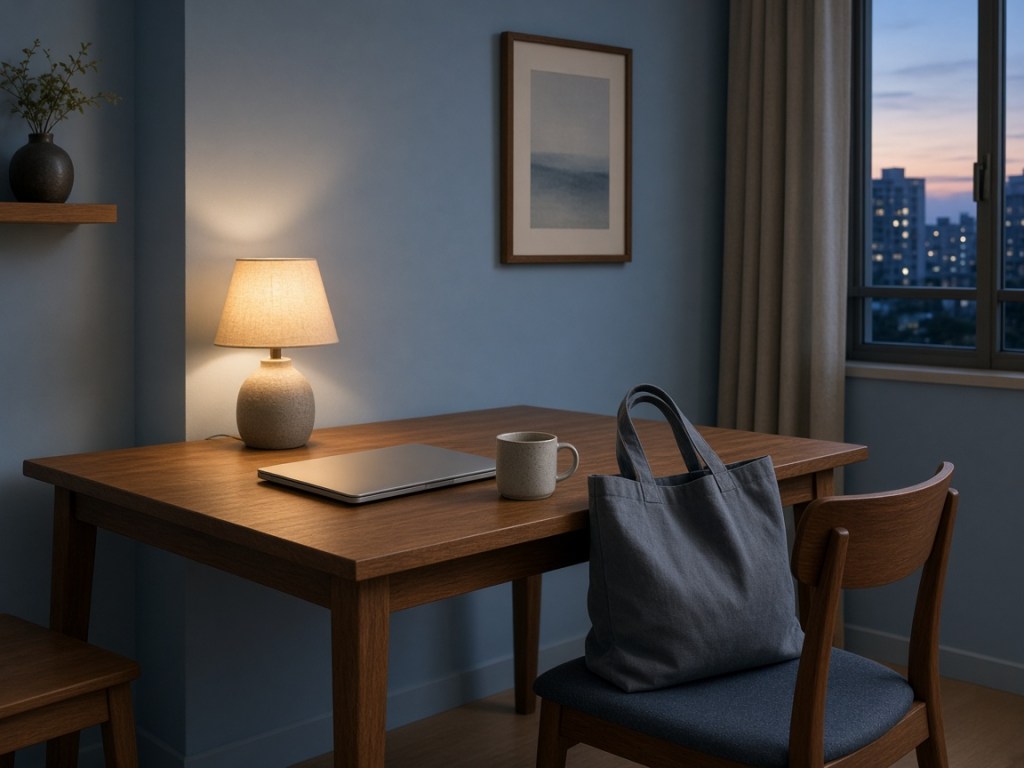
At the end of the day, a short walk and a change of scene often do more than another hour on the sofa with a laptop. If you like a little warmth after a long sit, that can be a warm shower, a short walk in the evening air, or a heat pack wrapped in a cloth. The NHS describes a heat pack or a hot-water bottle wrapped in a tea towel as one comfort option, used warm rather than uncomfortably hot, and not on swollen or freshly injured skin. Warmth is optional. It is not a treatment, and it does not replace movement or professional care.
A commentary in CNA has also noted that working from home can blur the line between work and the rest of life. Closing the laptop, clearing the dining table and leaving the room — even to walk downstairs — helps the day end as a day, rather than as an endless sit.
If you only change one thing
Stand up every half hour, in the office and at home. If you add a second habit, sit all the way back with your feet supported. Comfort tools, if you want them, come after those two.
FAQ
Should my home setup match my office setup?
It should follow the same principles — sit back, support your feet, raise the screen, take breaks — but the furniture will differ. Matching the two rooms exactly is rarely possible, and not necessary.
How often should I get up?
HealthHub’s working figure is about every thirty minutes. The useful interval is one you will actually keep when the calendar is full. A short stand is enough; you do not need a workout.
What if I cannot change the office chair?
Change what you can: how far back you sit, where your feet rest, the height of the screen, and how often you stand. A rolled towel or a small lumbar cushion may be allowed; if it is not, movement still is.
Does a cushion replace standing breaks?
No. A cushion is for the hours you still have to sit. The more important habit is to change position and to get up.
Is warmth a good idea after work?
It can be a pleasant end to a long sit for some people, if it is gentle and brief. It is not necessary, and it is not a substitute for a walk, sleep or seeing a clinician if something is wrong.
When should I see a professional?
If discomfort is severe, persistent or worrying, or if you notice warning symptoms such as weakness, numbness, or a change in bladder or bowel control, see a healthcare professional. A more comfortable desk setup is not a substitute for care.
Sources
- Mayo Clinic. Back pain — symptoms and causes (lower-back support, knee and hip level, change position at least every half hour).
- NIH Office of Research Services. Ergonomics — chairs.
- Harvard Health Publishing. Reduce or avoid back pain during these everyday activities (movement about every hour; lumbar pillow as a desk-work option).
- HealthHub Singapore. Nine ways to be a healthy, happy telecommuter.
- HealthHub Singapore. Self-help tips to manage pain (change position about every thirty minutes).
- HealthHub Singapore. Low back pain (no single best posture).
- NHS. Sitting exercises (optional gentle chair-based movements).
- NHS. Back pain (heat pack or hot-water bottle wrapped in a tea towel; stay active).
- The Straits Times, 26 Nov 2025. Citing the 2026 Asia Pacific Workplace Insights report by Colliers: 87 per cent of organisations in Singapore allowed staff to split time between home and the office.
- CNA. IN FOCUS: Why the stigma over flexible work persists in Singapore (Apr 2026). Ministry of Manpower: around seven in 10 firms offered flexible work arrangements; tripartite guidelines since late 2024.
- The Straits Times. There is more to just sitting or standing at your desk (Sep 2023, updated 2024).
- CNA Commentary. Working from home isn’t the flexibility that Singapore families need from employers (Victor Seah, Apr 2026), on work-home boundary blurring.
A soft next step. Stand up every half hour, sit back with your feet supported, and end the day with a short walk or a little warmth if you like it. If you later want more support on a chair you cannot change, add only the piece that matches the gap — a seat cushion for a hard seat, or a lumbar cushion or rolled towel for a bare backrest. Use it for the hours you have to sit, and still get up and move.

